Embedded Systems And IOT
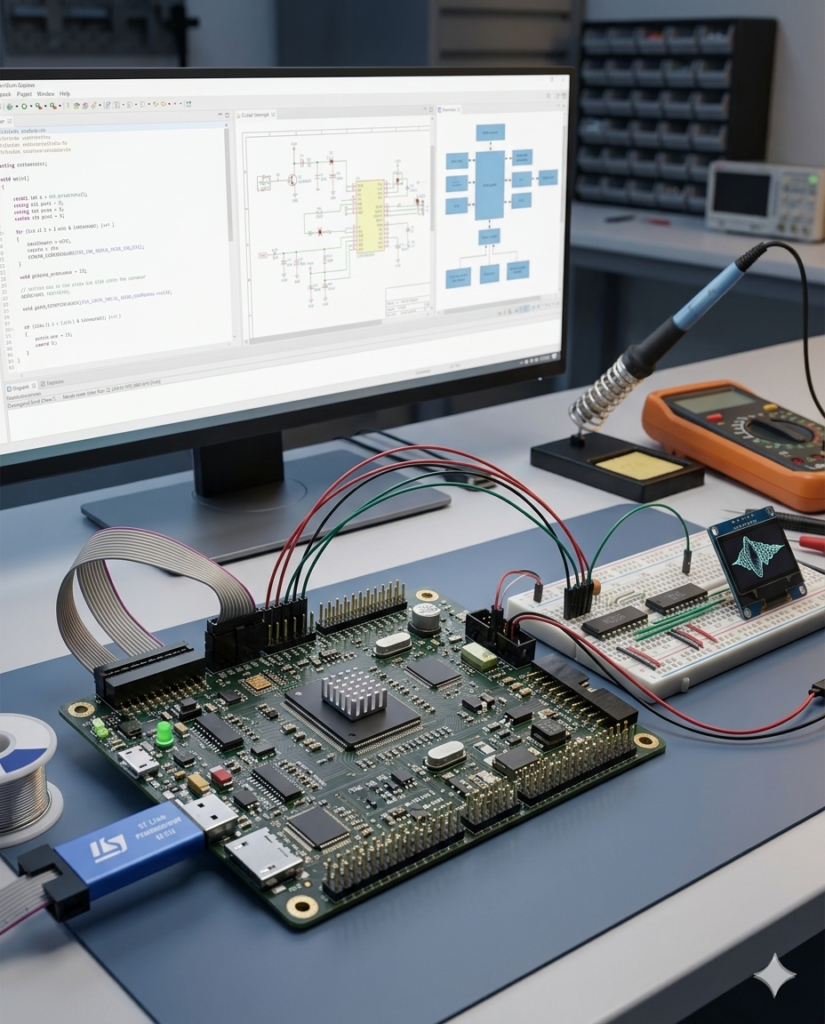
Embedded Systems Designs
Our mission is to be a premier engineering and hardware design partner, bridging the gap between physical components and intelligent software. By leveraging state-of-the-art microcontrollers, edge-AI processing, and robust firmware architecture, we develop custom embedded solutions that power the next generation of smart devices. We are committed to delivering high-performance, energy-efficient, and scalable designs that seamlessly drive automation and connectivity across industries.
To pioneer intelligent hardware solutions by seamlessly integrating AI and machine learning at the edge.
To architect low-power, high-efficiency systems tailored for complex industrial, automotive, and consumer electronics applications.
To provide end-to-end development architecture, from initial schematic design and PCB layout to firmware optimization and rigorous testing.
To bridge the gap between IoT connectivity and hardware security, ensuring robust data processing and secure device ecosystems.
To empower businesses to scale by transforming complex engineering challenges into market-ready, micro-targeted technology products.
✅ TASK 1: RTOS Part-3: Automating the Scheduling with Round-Robin Policy
🎯 Objective:
The primary objective of this session is to understand time-sliced task execution within a Real-Time Operating System. Interns will study how a scheduler manages multiple threads sharing the exact same priority level. By implementing a Round-Robin policy, you will learn how the kernel uses the system tick to enforce equal CPU time-sharing, ensuring no single thread hogging resources starves out equal-priority tasks.
📹 Session:
👉 Click here to Watch your uploaded session
📝 Task:
Write notes on:
Principles of Time-Slicing and Quantums in RTOS Kernels
Mechanism of the Round-Robin Scheduling Policy
How the Kernel Tracks and Rotates Threads of Equal Priority
The Role of the System Tick Interrupt in Enforcing Time Quotas
Understanding Preemption Within the Context of Equal Priorities
Assessing System Overhead Caused by Frequent Time-Slice Context Switches
🔬 Practice / Research:
Research what a “Time Quantum” or “Time Slice” is and what factors an engineer considers when deciding its duration (e.g., 1ms vs. 10ms). Write a short summary detailing the differences between a pure FIFO (First-In, First-Out) scheduling policy and a Round-Robin policy. List 3 negative side-effects that can occur if your RTOS time slice is configured to be too small.
📄 Practice Activity:
Write a short paragraph explaining: “Why Round-Robin scheduling is critical for handling communication tasks or human interface inputs that require predictable, shared CPU access.”
📊 Internship Task Completion Status Form:
After completing this task, interns must fill out the Internship Task Completion Status Form and upload their notes/practice work.
🔗 Form Link: https://forms.gle/kArakCDLG6aeCn218
✅ TASK 2: RTOS Part-4: Efficient Blocking of Threads
🎯 Objective:
The primary objective of this session is to master CPU resource preservation through efficient thread blocking. In complex embedded configurations, having a task sit in a continuous loop waiting for a hardware flag wastes massive processing cycles. Interns will explore kernel states to understand how tasks voluntarily yield execution and enter a “Blocked” state, allowing the CPU to perform other meaningful work until the exact resource or delay timer expires.
📹 Session:
👉 Click here to Watch your uploaded session
📝 Task:
Write notes on:
The Difference Between Active Polling (Spin-locks) and Non-Blocking Yielding
Understanding the Architecture of the RTOS “Blocked” or “Waiting” State
How the Scheduler Removes Blocked Threads from the Ready List
Implementing Resource-Efficient Software Delays (e.g.,
vTaskDelay())Wake-up Mechanics: How Timers and Hardware Events Move a Thread Back to “Ready”
Impact of Blocked Threads on Microcontroller Thermal Performance and Power Saving
🔬 Practice / Research:
Research how an RTOS tracks blocking time without having to constantly calculate math formulas for every single sleeping thread. Write a short summary comparing the CPU usage of a thread using a raw hardware loop delay versus a proper RTOS kernel sleep function. List 3 system triggers or API calls that typically cause a running thread to transition safely into a blocked state.
📄 Practice Activity:
Write a short paragraph explaining: “How transitioning a slow sensor-reading thread into a blocked state directly frees up the microcontroller core to process fast, safety-critical tasks running on other threads.”
📊 Internship Task Completion Status Form:
After completing this task, interns must fill out the Internship Task Completion Status Form and upload their notes/practice work.
🔗 Form Link: https://forms.gle/kArakCDLG6aeCn218
✅ TASK 3: RTOS Part-5: What is Real-Time? Preemptive, Priority-Based Scheduling
🎯 Objective:
The primary objective of this session is to dissect the core definition of “Real-Time” computing, focusing entirely on determinism and preemption. Interns will study how priority-based scheduling allows an urgent, safety-critical thread to instantly halt a lower-priority task mid-execution. By mastering preemptive scheduling algorithms, you will learn to build systems that guarantee deadlines are met under worst-case timing workloads.
📹 Session:
👉 Click here to Watch your uploaded session
📝 Task:
Write notes on:
Defining “Real-Time”: Hard Real-Time vs. Soft Real-Time Systems
Core Architecture of a Deterministic, Preemptive, Priority-Based Scheduler
The Mechanics of Immediate Preemption: Thread Interruptions at the Microsecond Level
Designing a Clean Thread Priority Hierarchy for Complex Firmware
The Threat of Starvation: How High-Priority Tasks Can Permanently Block Low-Priority Code
Analyzing Worst-Case Execution Time (WCET) to Ensure System Deadlines
🔬 Practice / Research:
Research a real-world engineering failure (such as the Mars Pathfinder priority inversion issue) caused by a breakdown in real-time priority scheduling logic. Write a short summary explaining why a desktop operating system (like Windows or macOS) is not considered a true “Hard Real-Time” system. List 3 distinct architectural rules for assigning high priorities versus low priorities to your various application threads.
📄 Practice Activity:
Write a short paragraph explaining: “The difference between a system that runs ‘incredibly fast’ versus a system that is truly ‘deterministic,’ and why predictability matters more in safety critical firmware.”
📊 Internship Task Completion Status Form:
After completing this task, interns must fill out the Internship Task Completion Status Form and upload their notes/practice work.
🔗 Form Link: https://forms.gle/kArakCDLG6aeCn218
✅ TASK 4: RTOS Part-6: Synchronization and Communication Among Concurrent Threads
🎯 Objective:
The primary objective of this session is to implement secure Inter-Process Communication (IPC) patterns across isolated threads. Because preemptive kernels switch tasks unpredictably, sharing variables directly introduces extreme risks of data corruption. Interns will master core RTOS synchronization objects—such as Mutexes, Semaphores, and Message Queues—to coordinate actions and safely pass data buffers across running threads.
📹 Session:
👉 Click here to Watch your uploaded session
📝 Task:
Write notes on:
The Dangers of Shared Resource Management in Multithreaded Environments
Introduction to Inter-Process Communication (IPC) Architecture
Mutexes (Mutual Exclusion) vs. Binary Semaphores: Definitions and Use Cases
Utilizing Counting Semaphores to Manage Shared Resource Pools
Passing Structured Data Packets Safely Using RTOS Message Queues
Identifying Complex Multithreading Pitfalls: Deadlocks and Priority Inversion
Best Practices for Avoiding Thread Synchronization Lock-ups
🔬 Practice / Research:
Research the fundamental difference between a Mutex and a Binary Semaphore, highlighting the concept of “Priority Inheritance/Ownership.” Write a short summary explaining how an RTOS Message Queue copies or references data internally to protect it from being altered by other threads mid-transmission. List 3 conditions that must occur simultaneously for an application to lock up completely due to a “Deadlock.”
📄 Practice Activity:
Write a short paragraph explaining: “How a data queue acts as an isolated buffer, allowing a high-speed data acquisition thread to pass messages cleanly to a slow flash-logging thread without either blocking each other.”
📊 Internship Task Completion Status Form:
After completing this task, interns must fill out the Internship Task Completion Status Form and upload their notes/practice work.
🔗 Form Link: https://forms.gle/kArakCDLG6aeCn218
✅ TASK 5: OOP Part-1: Encapsulation (Classes) in C and C++
🎯 Objective:
The primary objective of this session is to introduce Object-Oriented Design patterns to firmware architectures, mastering the concept of Encapsulation. Interns will learn how to transition from chaotic global variables to structured, clean modular blueprints. You will study how to bind hardware attributes (like pin numbers or registers) and methods (like init or toggle functions) inside a class wrapper, preventing external code modules from corrupting a peripheral’s inner configuration.
📹 Session:
👉 Click here to Watch your uploaded session
📝 Task:
Write notes on:
Paradigm Shift: Procedural Programming vs. Object-Oriented Programming (OOP)
The Concept of Encapsulation: Grouping Data and Methods Safely Together
Anatomy of a Class: Private vs. Public Access Specifiers in Embedded Layouts
Simulating Object Behavior in Pure C Using Structs and Function Pointers
The Role of Constructors and Destructors in Initializing Chip Peripherals
Memory Considerations: Static Allocation vs. Dynamic Object Creation (
new/delete) in Microcontrollers
🔬 Practice / Research:
Research why many automotive and defense firmwares strictly ban the use of the new keyword and dynamic heap memory allocation during runtime. Write a short code example or summary showing how a C struct combined with a custom header file can achieve basic data isolation similar to a private class in C++. List 3 practical benefits of wrapping a hardware driver (like an I2C LCD screen driver) inside an encapsulated class object.
📄 Practice Activity:
Write a short paragraph explaining: “How isolating internal class mechanics using ‘private’ attributes protects an underlying hardware profile from being accidentally misconfigured by other developers working on the application layer.”
📊 Internship Task Completion Status Form:
After completing this task, interns must fill out the Internship Task Completion Status Form and upload their notes/practice work.
🔗 Form Link: https://forms.gle/kArakCDLG6aeCn218
✅ TASK 6: OOP Part-2: Inheritance in C and C++
🎯 Objective:
The primary objective of this session is to master structural code reuse and hardware abstraction scaling using Inheritance. In embedded development, you often encounter multiple variations of a component (e.g., different types of motor drivers, or basic vs. advanced display units). Interns will learn how to establish a Base Class containing universal parameters, allowing Child Classes to inherit those core attributes while extending specific functionalities without duplicating foundational logic.
📹 Session:
👉Click here to Watch your uploaded session
📝 Task:
Write notes on:
Principles of Code Reusability and Modularity via Class Hierarchies
Defining the Base Class (Parent) vs. Derived Class (Child) Relationship
Understanding Access Modifiers within Inheritance Paths: The
protectedSpecifierMemory footprint layout of an inherited class object inside Microcontroller RAM
Simulating Base and Derived structures in Pure C using nested structures
Avoidance of Complex Patterns: The Hazards of Multiple Inheritance in Small Embedded Blueprints
🔬 Practice / Research:
Research how an optimizing compiler compiles a derived class object, mapping out how the memory of the base properties and derived properties are arranged sequentially. Write a short summary explaining a scenario where a generic base class called “Sensor” can be expanded into derived classes like “TemperatureSensor” and “PressureSensor”. List 3 optimization challenges that can arise if an inheritance chain is built too deep (e.g., 5 or more levels of nested classes).
📄 Practice Activity:
Write a short paragraph explaining: “How using inheritance allows an engineering team to write a foundational, certified communication class once and safely adapt it across multiple new hardware variants.”
📊 Internship Task Completion Status Form:
After completing this task, interns must fill out the Internship Task Completion Status Form and upload their notes/practice work.
🔗 Form Link: https://forms.gle/kArakCDLG6aeCn218
✅ TASK 7: OOP Part-4: Polymorphism in C
🎯 Objective:
The primary objective of this session is to understand Polymorphism and runtime interface abstractions, specifically analyzing how this dynamic behavior is mapped down to low-level environments. Interns will study how a unified interface can trigger completely different underlying hardware responses depending on the active object. You will pull back the curtain on how object-oriented frameworks use Virtual Method Tables (vtables) under the hood and learn how to implement these scalable interface matrices directly in bare-metal systems.
📹 Session:
👉 Click here to Watch your uploaded session
📝 Task:
Write notes on:
Defining Polymorphism: A Unified Software Interface with Distinct Hardware Behaviors
Runtime (Dynamic) vs. Compile-time (Static) Binding in Embedded Contexts
Understanding Virtual Functions and the Hidden Cost of the Virtual Table (
vtable)Step-by-Step Execution: How a Pointer Resolves a Method Call at Runtime via the Vtable
Replicating Polymorphic Interfaces in Standard C Using Arrays of Function Pointers
RAM/ROM Overhead Analysis of Dynamic Virtual Binding on Low-Cost Hardware Chips
🔬 Practice / Research:
Research the exact memory overhead (in bytes of RAM and FLASH) added to an object hierarchy when a function is marked as virtual in an embedded compiler. Write a short summary explaining how an abstract interface class like “Display” allows developers to write application code completely independent of whether the physical hardware screen uses an SPI or I2C bus channel. List 3 common architecture use cases in robotics or automation where dynamic polymorphism streamlines control code structures.
📄 Practice Activity:
Write a short paragraph explaining: “Why implementing polymorphism through manual function-pointer arrays in C can sometimes be preferred over native C++ virtual tables in highly resource-constrained microcontrollers.”
📊 Internship Task Completion Status Form:
After completing this task, interns must fill out the Internship Task Completion Status Form and upload their notes/practice work.