Embedded Systems And IOT
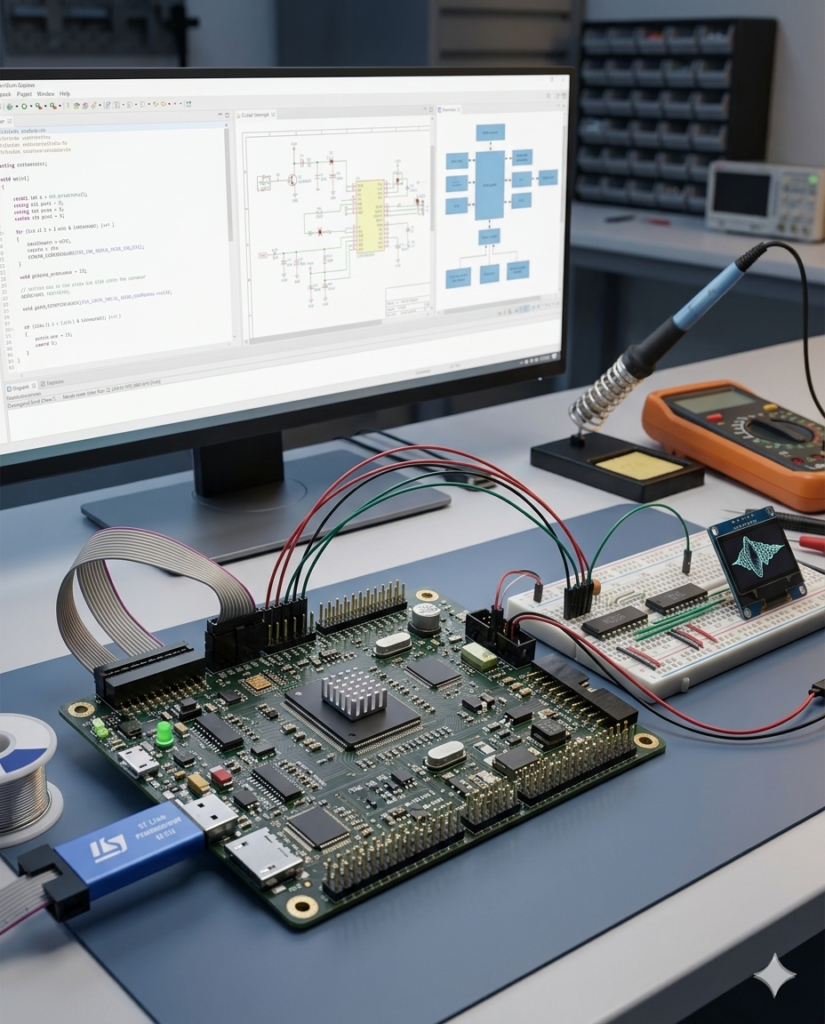
Embedded Systems Designs
Our mission is to be a premier engineering and hardware design partner, bridging the gap between physical components and intelligent software. By leveraging state-of-the-art microcontrollers, edge-AI processing, and robust firmware architecture, we develop custom embedded solutions that power the next generation of smart devices. We are committed to delivering high-performance, energy-efficient, and scalable designs that seamlessly drive automation and connectivity across industries.
To pioneer intelligent hardware solutions by seamlessly integrating AI and machine learning at the edge.
To architect low-power, high-efficiency systems tailored for complex industrial, automotive, and consumer electronics applications.
To provide end-to-end development architecture, from initial schematic design and PCB layout to firmware optimization and rigorous testing.
To bridge the gap between IoT connectivity and hardware security, ensuring robust data processing and secure device ecosystems.
To empower businesses to scale by transforming complex engineering challenges into market-ready, micro-targeted technology products.
✅ TASK 1: Startup Code Part-3: Vector Table Initialization and Exception Handlers
🎯 Objective:
The primary objective of this session is to bridge hardware exceptions with C software handlers. Interns will study how to map the physical vector table directly to interrupt service routines (ISRs) in code. By configuring low-level fault exception vectors, you will learn how to trap hardware errors and implement diagnostic safety nets for bare-metal ARM Cortex-M processors.
📹 Session:
👉 Click here to Watch your uploaded session
📝 Task:
Write notes on:
Structure and Layout of an ARM Cortex-M Exception Vector Table
Mapping Assembly Exception Entry Points to C-Language Interrupt Handlers
Writing Custom Exception Handlers for Hardware Faults (e.g., HardFault, UsageFault)
The Role of the Default Handler Vector Loop (
Default_Handler)Defining Weak Linkage Symbols (
[WEAK]) for Flexible Function OverridingMemory Alignment Requirements for Placing the Vector Table in Flash Memory
🔬 Practice / Research:
Research why the [WEAK] attribute is used when declaring interrupt handler symbols in a startup file. Write a short summary explaining how an ARM processor determines which software function to call when an exception occurs. List 3 standard system exceptions that sit at the top of an ARM vector table before peripheral interrupts begin.
📄 Practice Activity:
Write a short paragraph explaining: “How a generic infinite-loop fallback handler (Default_Handler) prevents a system from wandering into corrupt memory spaces when an unconfigured interrupt triggers.”
📊 Internship Task Completion Status Form:
After completing this task, interns must fill out the Internship Task Completion Status Form and upload their notes/practice work.
🔗 Form Link: https://forms.gle/kArakCDLG6aeCn218
✅ TASK 2: Interrupts Part-1: What are Interrupts, and How They Work
🎯 Objective:
The primary objective of this session is to move away from inefficient continuous software loops and embrace asynchronous, event-driven hardware execution. Interns will study the lifecycle of a hardware interrupt, from the initial physical trigger to the automatic saving of CPU registers on the stack frame. Mastering these concepts allows you to write highly responsive firmware that instantly reacts to unpredictable physical world events.
📹 Session:
👉 Click here to Watch your uploaded session
📝 Task:
Write notes on:
Polling Architecture vs. Interrupt-Driven Hardware Architectures
Hardware Anatomy of an Interrupt: Latency, Flags, and Enable Bits
The Step-by-Step Execution Journey from Core Code to an active ISR
Automatic Context Saving: How the CPU Hardware Pushes Registers onto the Stack
Clearing Peripheral Interrupt Flags to Avoid Infinite Retriggering Loops
Designing Compact, High-Speed Interrupt Service Routines (ISRs)
🔬 Practice / Research:
Research what “Interrupt Latency” means and list 2 hardware factors that directly cause delays before an ISR runs. Write a short summary explaining what happens if an engineer forgets to clear the interrupt flag inside a peripheral’s handler routine. List 3 common hardware sources that typically trigger asynchronous interrupts rather than being constantly checked via software code.
📄 Practice Activity:
Write a short paragraph explaining: “Why it is considered incredibly bad design practice to put processing delays or heavy printing functions inside an Interrupt Service Routine.”
📊 Internship Task Completion Status Form:
After completing this task, interns must fill out the Internship Task Completion Status Form and upload their notes/practice work.
🔗 Form Link: https://forms.gle/kArakCDLG6aeCn218
✅ TASK 3: Interrupts Part-3: How Interrupts Work on ARM Cortex-M
🎯 Objective:
The primary objective of this session is to master the Nested Vectored Interrupt Controller (NVIC) built into the core of ARM Cortex-M microcontrollers. Interns will study priority structures, nested execution paths, and how the CPU switches context between multiple active interrupts. By mastering the hardware NVIC interface, you will learn to manage overlapping real-time tasks without sacrificing system responsiveness.
📹 Session:
👉 Click here to Watch your uploaded session
📝 Task:
Write notes on:
Role and Architecture of the ARM Nested Vectored Interrupt Controller (NVIC)
Understanding Core Interrupt Priorities: Preemption Priority vs. Sub-Priority
The Mechanics of Interrupt Nesting: How a High-Priority ISR Interrupts a Lower One
Configuring Core NVIC Registers Using CMSIS Function Call Standards
Tail-Chaining and Late-Arrival Optimization Mechanisms Built into ARM Silicon
Managing Shared Stack Spaces During Multiple Levels of Interrupt Nesting
🔬 Practice / Research:
Research the difference between “Preemption Priority” and “Sub-Priority” on an ARM Cortex-M chip. Write a short summary explaining the concept of “Tail-Chaining” and how it saves clock cycles when processing consecutive interrupts. List 3 critical NVIC configuration steps required to successfully enable a peripheral interrupt line.
📄 Practice Activity:
Write a short paragraph explaining: “How the NVIC handles a situation where two distinct peripheral interrupts trigger at the exact same clock cycle.”
📊 Internship Task Completion Status Form:
After completing this task, interns must fill out the Internship Task Completion Status Form and upload their notes/practice work.
🔗 Form Link: https://forms.gle/kArakCDLG6aeCn218
✅ TASK 4: Race Conditions: What are They and How to Avoid Them
🎯 Objective:
The primary objective of this session is to tackle asynchronous data sharing vulnerabilities that threaten system stability. When a main software loop and an interrupt share the same variable, unsynchronized read-modify-write operations can lead to subtle data corruption. Interns will learn how to identify these “race conditions” and apply defensive coding tools—such as atomic actions and critical sections—to ensure absolute data consistency.
📹 Session:
👉 Click here to Watch your uploaded session
📝 Task:
Write notes on:
Definition of a Race Condition and Shared Resource Vulnerabilities
The Read-Modify-Write Problem at the Assembly Translation Level
Identifying Non-Atomic Operations on Shared Hardware Variables
The Vital Necessity of the
volatileKeyword in Shared Data ScenariosCreating Protected “Critical Sections” by Temporarily Masking Interrupt Lines
Utilizing Atomic Operations and Hardware Mutexes to Safely Guard Buffers
Best Software Design Practices for Eliminating Shared Global Variables
🔬 Practice / Research:
Research how a single line of C code like counter++ translates into multiple distinct assembly instructions, creating an ideal opening for a race condition. Write a short summary describing the operation of a “Critical Section” and how disabling interrupts keeps data safe. List 3 software bugs or hardware errors that can happen if an encoder calculation variable suffers from data corruption via a race condition.
📄 Practice Activity:
Write a short paragraph explaining: “How a race condition can slip past standard laboratory testing and only cause random, hard-to-reproduce crashes once deployed in production environments.”
📊 Internship Task Completion Status Form:
After completing this task, interns must fill out the Internship Task Completion Status Form and upload their notes/practice work.
🔗 Form Link: https://forms.gle/kArakCDLG6aeCn218
✅ TASK 5: Foreground-Background Architecture (Superloop)
🎯 Objective:
The primary objective of this session is to evaluate the standard system architecture used in traditional embedded firmware designs. Interns will analyze the layout of the Foreground-Background pattern—where background asynchronous ISR tasks handle immediate hardware events, and a foreground infinite superloop executes non-time-critical logic. You will map out its scheduling constraints, explore power-management benefits, and discover where this approach hits its limits as system complexity grows.
📹 Session:
👉 Click here to Watch your uploaded session
📝 Task:
Write notes on:
Structural Breakdown of Foreground-Background (Superloop) Topologies
Defining the Background Space (Interrupt-Driven, High-Priority, Urgent Actions)
Defining the Foreground Space (Main Continuous Loop, Low-Priority Task Management)
Communication Strategies: Passing Status Flags and Ring Buffers Between Layers
Measuring CPU Duty Cycles and Managing Power-Saving Modes Inside Superloops
Structural Boundaries: Why Big Applications Suffer Under Massive Superloops
Calculating Worst-Case Execution Jitter in Linear Tasks
🔬 Practice / Research:
Research how putting a blocking delay function (like delay_ms(500)) inside a main superloop ruins the responsiveness of other tasks sharing that loop. Write a short summary detailing how a Superloop system can drop into a low-power “Sleep” state when no hardware flags are active. List 3 types of commercial embedded electronics that are perfectly suited for Superloop architectures rather than needing a full operating system.
📄 Practice Activity:
Write a short paragraph explaining: “How task execution jitter changes under a Superloop design when one foreground task takes much longer to complete due to checking a slow external sensor.”
📊 Internship Task Completion Status Form:
After completing this task, interns must fill out the Internship Task Completion Status Form and upload their notes/practice work.
🔗 Form Link: https://forms.gle/kArakCDLG6aeCn218
✅ TASK 6: RTOS Part-2: Automating the Context Switch
🎯 Objective:
The primary objective of this session is to cross the threshold into advanced multithreading by studying how Real-Time Operating System (RTOS) kernels automate context switching. Interns will move beyond manual cooperative structures to explore deterministic, preemptive task scheduling. You will study how timer ticks trigger scheduler actions, how the CPU swaps task environments, and how an RTOS manages multiple independent program loops seamlessly on a single processor core.
📹 Session:
👉 Click here to Watch your uploaded session
📝 Task:
Write notes on:
Core Architecture of an RTOS Kernel vs. Traditional Superloop Patterns
The Automated Context Switch Mechanism: Saving and Restoring Task Registers
Understanding the RTOS System Tick Timer (
SysTick) as the Kernel HeartbeatTracking Thread Life Cycles: Ready, Running, Blocked, and Suspended States
The Role of PendSV (Pendable Service Call) Exceptions in Handling Safe Transitions
Working with the Task Control Block (TCB) and Assigning Isolated Task Stacks
Preemptive Scheduling Logic and its Real-Time Performance Advantages
🔬 Practice / Research:
Research why the ARM architecture uses the specific PendSV interrupt to run context switches rather than running them inside standard timer handler routines. Write a short summary explaining how an RTOS Scheduler manages task states when a high-priority thread transitions from “Blocked” to “Ready”. List 3 popular real-time operating systems widely utilized across automotive, medical, or consumer electronics industries.
📄 Practice Activity:
Write a short paragraph explaining: “How an automated context switch mimics running multiple CPUs simultaneously on a single microcontroller core, and why isolating task stacks is critical to safety.”
📊 Internship Task Completion Status Form:
After completing this task, interns must fill out the Internship Task Completion Status Form and upload their notes/practice work.