Embedded Systems And IOT
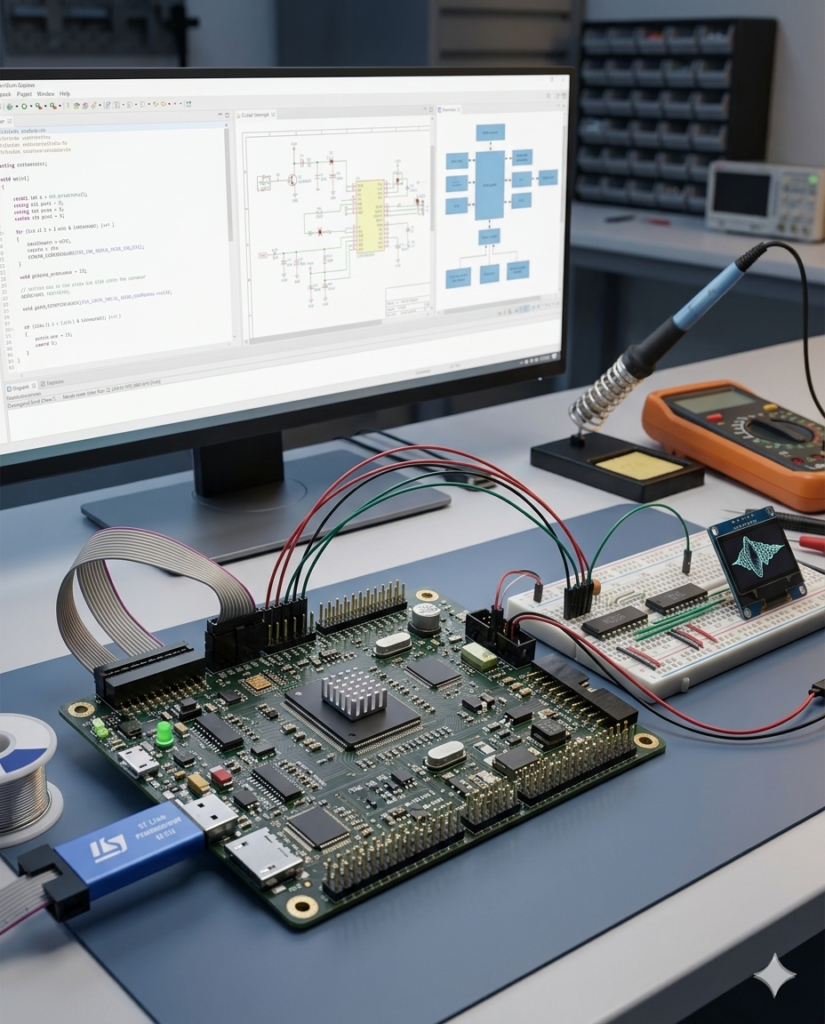
Embedded Systems Designs
Our mission is to be a premier engineering and hardware design partner, bridging the gap between physical components and intelligent software. By leveraging state-of-the-art microcontrollers, edge-AI processing, and robust firmware architecture, we develop custom embedded solutions that power the next generation of smart devices. We are committed to delivering high-performance, energy-efficient, and scalable designs that seamlessly drive automation and connectivity across industries.
To pioneer intelligent hardware solutions by seamlessly integrating AI and machine learning at the edge.
To architect low-power, high-efficiency systems tailored for complex industrial, automotive, and consumer electronics applications.
To provide end-to-end development architecture, from initial schematic design and PCB layout to firmware optimization and rigorous testing.
To bridge the gap between IoT connectivity and hardware security, ensuring robust data processing and secure device ecosystems.
To empower businesses to scale by transforming complex engineering challenges into market-ready, micro-targeted technology products.
✅ TASK 1: How Computers Count
🎯 Objective:
The primary objective of this session is to establish a solid foundational understanding of digital counting systems, focusing on how computers and embedded hardware natively interpret, store, and manipulate data. Students will bridge the gap between human-readable decimal notation and machine-level data representation by mastering binary and hexadecimal systems. By the end of this task, you will comprehend the mechanical relationship between hardware registers and software variables, enabling you to write more efficient firmware and anticipate structural limitations like data overflow in real-world microcontroller architectures.
📹 Session:
👉Click here to Watch your uploaded session
📝 Task:
Write notes on:
Introduction to Binary, Decimal, and Hexadecimal Systems
Difference Between Human Counting (Base 10) and Machine Counting (Base 2)
The Concept of Bits, Bytes, and Words in Microcontrollers
Hexadecimal Notation and its Relevance in Embedded Engineering
Binary Arithmetic and Bitwise Logic Basics
Memory Addressing and Register Value Representation
Unsigned vs. Signed Number Formats
Data Overflow and Underflow in Hardware Memory
🔬 Practice / Research:
Research how microcontrollers use binary code to interact with physical hardware registers. Write a short summary explaining why hexadecimal is preferred over binary for defining memory addresses. List 5 examples of common everyday devices that rely on 8-bit or 16-bit embedded system architectures.
📄 Practice Activity:
Write a short paragraph explaining: “How understanding digital counting systems helps an embedded engineer avoid critical software errors like integer overflow.”
📊 Internship Task Completion Status Form:
After completing this task, interns must fill out the Internship Task Completion Status Form and upload their notes/practice work.
🔗 Form Link: https://forms.gle/kArakCDLG6aeCn218
✅ TASK 2: How to Change the Flow of Control Through Your Code
🎯 Objective:
The core objective of this session is to master conditional logic and control flow mechanisms, which dictate how an embedded program responds dynamically to changing inputs and real-world sensor data. Interns will move beyond linear, top-to-bottom execution paths to implement decision-making constructs such as loops and conditional statements within highly constrained microcontrollers. By exploring these structures, you will learn how to optimize execution paths, minimize processing overhead, and manage responsive behaviors essential for real-time firmware development.
📹 Session:
👉 Click here to Watch your uploaded session
📝 Task:
Write notes on:
Introduction to Control Flow in Embedded Applications
Linear Execution vs. Conditional Execution Paths
Implementing Conditional Logic (
if,else if,else) for Hardware DecisionsUsing Multi-way Branching with
switch-caseStatementsLoop Structures (
while,do-while,for) and Their Lifecycle inside FirmwareBreak and Continue Statements within Hardware Loops
The Significance of the Infinite Loop (
while(1)) in Embedded System ArchitectureImpact of Complex Branching on Real-Time Microcontroller Performance
🔬 Practice / Research:
Research how conditional control flow statements directly affect the timing constraints of a real-time system. Write a short summary explaining why an infinite loop (such as while(1) or for(;;) ) is mandatory in the main routine of almost every embedded application. List 5 hardware components (e.g., a push button, a temperature threshold sensor) whose inputs heavily rely on conditional flow logic to trigger an action.
📄 Practice Activity:
Write a short paragraph explaining: “How nested loops or deeply layered conditional logic can introduce processing delays, and how an engineer can optimize control flow for efficient micro-processing.”
📊 Internship Task Completion Status Form:
After completing this task, interns must fill out the Internship Task Completion Status Form and upload their notes/practice work.
🔗 Form Link: https://forms.gle/kArakCDLG6aeCn218
✅ TASK 3: Variables and Pointers
🎯 Objective:
The primary objective of this session is to demystify memory management in embedded development by mastering the relationship between variables, data types, and pointers. Unlike web or desktop software, microcontrollers operate with extremely finite RAM. Interns will learn how variables map directly to physical memory addresses, how to manipulate hardware architecture using pointers, and how to optimize data tracking. Mastering these concepts is essential for managing memory constraints, interfacing directly with hardware registers, and writing high-performance firmware.
📹 Session:
👉 Click here to Watch your uploaded session
📝 Task:
Write notes on:
Understanding Microcontroller RAM and Data Storage
Primitive Data Types and Their Exact Memory Footprint (e.g.,
char,int,float)The Concept of Variable Declaration, Scope, and Initialization in Firmware
Introduction to Pointers: Memory Addresses vs. Contained Values
The Address-of Operator (
&) and De-reference Operator (*)Pointer Arithmetic and How Array Elements are Structured in Memory
The Risks of Dangling Pointers, Null Pointers, and Memory Leaks in Embedded C
Why Pointers are Essential for Accessing Special Function Registers (SFRs)
🔬 Practice / Research:
Research why the volatile keyword is frequently combined with pointers when mapping hardware register addresses in embedded systems. Write a short summary explaining the core difference between storing a variable on the Stack versus allocating memory dynamically (if applicable) in low-level systems. List 3 real-world programming bugs that commonly occur when pointers are handled incorrectly in firmware development.
📄 Practice Activity:
Write a short paragraph explaining: “Why passing variables via pointers (Pass-by-Reference) is significantly more efficient for a resource-constrained microcontroller than copying the entire variable data (Pass-by-Value).”
📊 Internship Task Completion Status Form:
After completing this task, interns must fill out the Internship Task Completion Status Form and upload their notes/practice work.
🔗 Form Link: https://forms.gle/kArakCDLG6aeCn218
✅ TASK 4: How to Control the World Outside
🎯 Objective:
The primary objective of this session is to understand how a microcontroller interacts with physical hardware peripherals and external electronic components. Interns will learn the fundamentals of General Purpose Input/Output (GPIO) pins, exploring how software commands translate into electrical signals to control external devices. By mastering input/output configuration and electrical characteristics, you will be able to interface a microcontroller with the outside world safely and effectively.
📹 Session:
👉Click here to Watch your uploaded session
📝 Task:
Write notes on:
Introduction to Peripherals and GPIO (General Purpose Input/Output)
Configuring Pins as Digital Inputs vs. Digital Outputs
Understanding High, Low, and High-Impedance (Hi-Z) States
Electrical Characteristics: Sourcing vs. Sinking Current
The Importance of Pull-Up and Pull-Down Resistors for Inputs
Interfacing Simple Actuators (LEDs, Buzzers, Relays)
Reading Digital Sensor Inputs and Push Buttons
Handling Hardware Bounce and Debouncing Techniques
🔬 Practice / Research:
Research why connecting a high-power hardware component (like a DC motor) directly to a microcontroller’s GPIO pin can damage the chip, and what isolation components are used instead. Write a short summary explaining the physical phenomenon of a “floating pin” when an input resistor is missing. List 5 types of external actuators or sensors commonly controlled via basic digital I/O lines.
📄 Practice Activity:
Write a short paragraph explaining: “The electronic difference between sourcing current and sinking current from a microcontroller pin, and how it changes your physical circuit wiring.”
📊 Internship Task Completion Status Form:
After completing this task, interns must fill out the Internship Task Completion Status Form and upload their notes/practice work.
🔗 Form Link: https://forms.gle/kArakCDLG6aeCn218
✅ TASK 5: Preprocessor and the _volatile_ Keyword in C
🎯 Objective:
The primary objective of this session is to master advanced memory and compilation safety features unique to embedded C programming. Interns will study the function of the C preprocessor in organizing embedded code and optimizing hardware macros. Additionally, you will deeply explore the critical role of the volatile keyword in preventing compiler optimizations that break hardware interactions, ensuring software safely updates when reading hardware registers modified by outside physical forces or interrupts.
📹 Session:
👉 Click here to Watch your uploaded session
📝 Task:
Write notes on:
The C Compilation Pipeline: Preprocessing, Compiling, and Linking
Working with Preprocessor Directives (
#define,#include,#ifdef,#ifndef)Creating Hardware Abstraction Macros for Pin and Register Manipulation
How Optimizing Compilers Treat Variables in Hardware Memory
The Purpose and Syntax of the
volatileKeyword in Embedded CSituations Requiring Volatile: Memory-Mapped I/O, Interrupt Service Routines (ISRs), and Shared Multi-threaded Variables
Consequences of Omitting
volatilein Hardware-Linked VariablesCombining
constandvolatileQualifiers Correctly
🔬 Practice / Research:
Research a real-world scenario where a compiler optimization completely breaks an embedded program loop because a hardware variable wasn’t marked as volatile. Write a short summary explaining why header guards (#ifndef, #define, #endif) are mandatory in embedded project files. List 3 specific hardware registers in a typical microcontroller framework that must be defined using the volatile keyword.
📄 Practice Activity:
Write a short paragraph explaining: “Why the compiler might assume an un-updated hardware register loop is dead code, and how the volatile keyword forces the CPU to physically re-read memory every single time.”
📊 Internship Task Completion Status Form:
After completing this task, interns must fill out the Internship Task Completion Status Form and upload their notes/practice work.
🔗 Form Link: https://forms.gle/kArakCDLG6aeCn218
✅ TASK 6: Bit-Wise Operators in C
🎯 Objective:
The primary objective of this session is to master bit-level data manipulation, which is an indispensable skill for configure-level firmware engineering. Because microcontrollers manipulate hardware features through individual bits inside registers, interns must master the mathematical logic used to change single bits without altering the rest of the register. You will learn how to read, modify, clear, and toggle specific configuration bits using binary math operations.
📹 Session:
👉 Click here to Watch your uploaded session
📝 Task:
Write notes on:
Core Bitwise Operators in C: AND (
&), OR (|), XOR (^), NOT (~)Working with Binary Bit-Shift Operators: Left Shift (
<<) and Right Shift (>>)The Concept of a “Bitmask” in Low-Level Engineering
Techniques for Bit Masking: Setting a Specific Bit (Bitwise OR)
Techniques for Bit Masking: Clearing a Specific Bit (Bitwise AND with NOT)
Techniques for Bit Masking: Toggling/Flipping a Specific Bit (Bitwise XOR)
Testing/Checking the Status of an Individual Pin or Flag Bit
Extracting Multiple Bits out of a Packed Hardware Data Byte
🔬 Practice / Research:
Research the code structure used to check if a specific bit (e.g., Bit 3) in an 8-bit register is currently set to 1 or 0. Write down the step-by-step binary math operation showing how the expression Register |= (1 << 5) sets bit 5 of a register. List 3 common hardware setups (like clock configurations or communication speeds) that require bitwise masking to turn on or off.
📄 Practice Activity:
Write a short paragraph explaining: “Why using bitwise operators to modify specific configuration flags is safer and cleaner than overwriting an entire hardware register with a brand new decimal value.”
📊 Internship Task Completion Status Form:
After completing this task, interns must fill out the Internship Task Completion Status Form and upload their notes/practice work.
🔗 Form Link: https://forms.gle/kArakCDLG6aeCn218
✅ TASK 7: Arrays and Pointer Arithmetic
🎯 Objective:
The primary objective of this session is to study advanced buffer and memory traversal by linking contiguous arrays with pointer operations. In embedded software, sensor data streams, communication packets, and display layouts are stored in arrays. Interns will learn how arrays are represented under the hood, how pointer arithmetic navigates data structures faster than traditional indexing, and how to safely manage data buffers without causing memory corruption.
📹 Session:
👉 Click here to Watch your uploaded session
📝 Task:
Write notes on:
Contiguous Memory Allocation of Arrays in Microcontroller RAM
The Structural Link Between Array Names and Base Pointers
Navigating Memory Spaces with Pointer Arithmetic (Incrementing/Decrementing Pointers)
Data Type Scaling: How Pointer Offsets Scale Automatically Based on Element Size
Accessing Array Elements Using Pointer De-referencing vs. Bracket Indexing (
*(ptr + i)vs.arr[i])Passing Arrays into Functions Safely Using Pointers
Risks of Out-of-Bounds Memory Traversal and Buffer Overflows
Constant Arrays (
const) and Their Storage Optimization in Flash Memory (ROM)
🔬 Practice / Research:
Research why incrementing a pointer (ptr++) pointing to a 32-bit integer array changes the physical memory address address by 4 bytes instead of just 1 byte. Write a short summary explaining how a buffer overflow bug can corrupt adjacent hardware variable values stored in RAM. List 3 common data structures in embedded communications (such as UART strings or SPI buffers) that rely completely on array pointer structures.
📄 Practice Activity:
Write a short paragraph explaining: “The execution speed and efficiency advantages of using direct pointer arithmetic to traverse sequential sensor data stored inside an array instead of standard array index lookup counters.”
📊 Internship Task Completion Status Form:
After completing this task, interns must fill out the Internship Task Completion Status Form and upload their notes/practice work.
🔗 Form Link: https://forms.gle/kArakCDLG6aeCn218