Drone Technology & UAV Design Training cum Internship Program – Design, Simulation, Embedded Systems and AI
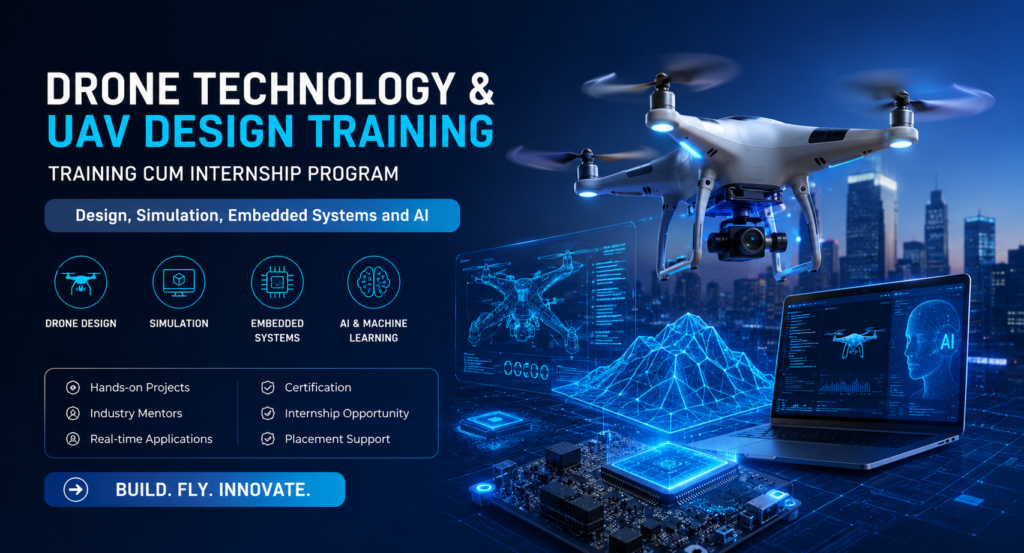
Drone Technology & UAV Design Training cum Internship Program
Our mission is to empower aspiring engineers, innovators, and technology enthusiasts with industry-relevant expertise in Drone Technology and UAV Design. Through a comprehensive blend of design, simulation, embedded systems, artificial intelligence, and real-world project experience, this program prepares participants to build the next generation of intelligent aerial systems.
- To provide hands-on training in UAV design, development, and testing methodologies.
- To equip students with practical skills in drone simulation, flight control systems, and aerodynamics.
- To develop expertise in embedded systems, sensors, microcontrollers, and communication protocols used in modern UAVs.
- To integrate Artificial Intelligence, Computer Vision, and Machine Learning into autonomous drone applications.
- To offer industry-oriented internship experience through live projects, mentorship, and research-driven activities.
- To prepare participants for careers in aerospace, robotics, defense, agriculture, surveillance, mapping, logistics, and emerging drone technologies.
- To foster innovation, problem-solving, and entrepreneurial thinking in the rapidly growing UAV ecosystem.
- To bridge the gap between academic learning and industry requirements through practical exposure and certification.
To establish a unique presence in the global marketplace.
To extend our software development services across every corner of the world.
To be the premier one-stop destination for comprehensive technology solutions.
To deliver cutting-edge innovations on a global scale.
To inspire clients to “imagine and invent” their future through an innovation-driven approach.
📘 SESSION 1: Drone Programming
🎯 Objective:
To understand the fundamental concepts of drone programming, including how software controls drone operations, enables autonomous flight, and supports real-world applications of unmanned aerial vehicles (UAVs).
📹 Session:
👉 Click here to Watch your uploaded session
📝 Session Description:
Drone programming forms the foundation of modern UAV technology. Drones rely on software to process sensor data, navigate environments, maintain flight stability, and perform automated missions. This session introduces learners to the key concepts of drone programming, flight control systems, navigation technologies, and real-world drone applications.
Students will explore how software and hardware work together to create intelligent drone systems capable of operating in agriculture, logistics, mapping, surveillance, disaster response, and many other industries.
📋 Assignment
Assignment 1: Understanding Drone Technology
Write a brief report (300–500 words) covering:
What is a Drone (UAV)?
Main components of a drone
How drone software controls flight
Importance of sensors and GPS systems
Applications of drones in modern industries
Assignment 2: Industry Research
Research any three industries that use drones and explain:
How drones are used
Benefits provided by drones
Challenges faced during drone deployment
(200–300 words)
Assignment 3: Case Study Analysis
Choose one real-world drone application (Agriculture, Delivery, Surveillance, Mapping, etc.) and explain:
Problem being solved
How drones are used
Benefits achieved
Future improvements
(250–400 words)
Assignment 4: Reflection Activity
Write a short paragraph explaining:
“Why drone programming is becoming an important skill in the future of technology and automation.”
(100–150 words)
📤 Assignment Submission
After completing all assignments, combine your work into a single PDF or Word document and upload it using the submission form below.
🔗 Assignment Submission Form:
👉 https://forms.gle/kArakCDLG6aeCn218
🟦 SESSION 2: Course Overview for Programming Drones
🌐 Objective:
To understand the overall structure, learning path, prerequisites, and key milestones of the drone programming curriculum, ensuring complete readiness for advanced autonomous systems development.
🎬 Session:
👉 Click here to Watch your uploaded session
📝 Session Description:
This session provides a comprehensive roadmap for mastering drone programming. It introduces the core software stacks, simulation environments, hardware architectures, and project milestones learners will navigate throughout the curriculum.
Students will explore how foundational software engineering concepts link directly to autonomous flight control. By understanding the big picture early, learners can establish a solid framework for interpreting complex open-source codebases and modern UAV ecosystems.
📋 Assignment
Assignment 1: Course Roadmap and Prerequisites
Write a brief report (300–500 words) covering:
What is drone programming and why does it require specialized architectures?
Essential programming languages and foundational skills required.
Key milestones and progression path of this course.
Overview of simulation vs. hardware-in-the-loop environments.
Setting personal learning goals for the curriculum.
Assignment 2: Tooling and Environment Research
Research any three tools or software applications commonly used in drone development simulations and explain:
Features and primary functions of the software
Benefits provided to developers during testing
System requirements and cross-platform compatibility (200–300 words)
Assignment 3: Curriculum Milestone Analysis
Choose one major advanced drone capability (e.g., Autonomous Waypoint Navigation, Computer Vision Integration, Obstacle Avoidance, Payload Control) and explain:
The core problem being solved
How programming enables this capability
Safety benefits achieved
Future advancements in this specific technical area (250–400 words)
Assignment 4: Reflection Activity
Write a short paragraph explaining:
“Why is establishing a structured, simulation-first learning path crucial before deploying custom code onto physical drone hardware?” (100–150 words)
📥 Assignment Submission
After completing all assignments, combine your work into a single PDF or Word document and upload it using the submission form below.
🔗 Assignment Submission Form:
👉 https://forms.gle/kArakCDLG6aeCn218
🟦 SESSION 3: High Level Perspective of a Flight Stack _ Drone Programming
🌐 Objective:
To analyze the architecture of a modern drone flight stack, understanding how low-level hardware control, real-time operating systems, middleware, and high-level flight logic interact to achieve stable flight.
🎬 Session:
👉 Click here to Watch your uploaded session
📝 Session Description:
This session demystifies the internal software architecture of an autonomous drone, universally known as the flight stack. Learners will explore the distinct layer boundaries that separate raw sensor inputs, real-time stabilization loops, and high-level autonomous mission command execution.
Special emphasis is placed on understanding the flow of data: how a command translates down through the software layers to ultimately modify motor speeds. Students will examine the critical balance between deterministic real-time processing and complex application computing.
📋 Assignment
Assignment 1: Demystifying the Flight Stack
Write a brief report (300–500 words) covering:
Definition and primary purpose of a flight stack
The role of the Real-Time Operating System (RTOS) in flight control
Differences between the stabilization loop (low level) and mission planning (high level)
How sensor data (IMU, Barometer) flows up through the software stack
The importance of modular design in modern flight stack frameworks
Assignment 2: Communication Protocols
Research any three communication protocols or APIs used within or alongside flight stacks (e.g., MAVLink, uORB, PWM, DShot) and explain:
How they handle data transmission
Benefits provided to flight stability or system monitoring
Challenges or latency constraints associated with each (200–300 words)
Assignment 3: Flight Stack Layer Failure Analysis
Choose one specific layer of a standard flight stack architecture (Hardware Abstraction Layer, Core Flight Control, or Middleware Command Layer) and explain:
The primary structural problem being managed by this layer
How software errors manifest at this layer during flight
Safety mechanisms and failsafes engineered to mitigate these errors
Future improvements in flight stack layer isolation (250–400 words)
Assignment 4: Reflection Activity
Write a short paragraph explaining:
“Why must a drone’s core flight control software operate on deterministic timing principles, and what happens if a process delays by even a few milliseconds?” (100–150 words)
📥 Assignment Submission
After completing all assignments, combine your work into a single PDF or Word document and upload it using the submission form below.
🔗 Assignment Submission Form:
👉 https://forms.gle/kArakCDLG6aeCn218
🟦 SESSION 4: ArduPilot Introduction _ Open Source Drones
🌐 Objective:
To explore the ArduPilot open-source ecosystem, evaluating its rich feature capabilities, vehicle versatility, architectural modules, and its sweeping impact across the global commercial UAV industry.
🎬 Session:
👉 Click here to Watch your uploaded session
📝 Session Description:
This session introduces ArduPilot, one of the most sophisticated, reliable, and widely deployed open-source autopilot software suites in existence. Learners will study the history and architecture of this ecosystem, finding out how a single codebase successfully powers multirotors, fixed-wing aircraft, ground rovers, and submarines.
Students will analyze how community-driven open-source development creates robust software capable of competing with—and often exceeding—expensive proprietary configurations. This foundation will prepare learners to interface intelligently with ArduPilot setups globally.
📋 Assignment
Assignment 1: Unpacking ArduPilot
Write a brief report (300–500 words) covering:
History and evolution of the ArduPilot project
The core vehicle types supported (Copter, Plane, Rover, Sub)
Key architectural modules within ArduPilot code
Main advantages of open-source autopilots over proprietary closed systems
Real-world commercial applications utilizing ArduPilot today
Assignment 2: ArduPilot Ground Control Stations
Research any three Ground Control Station (GCS) applications compatible with ArduPilot (e.g., Mission Planner, QGroundControl, Tower, APM Planner) and explain:
How they connect and communicate with ArduPilot firmware
Unique benefits provided by each interface
Challenges or operational limitations of each software (200–300 words)
Assignment 3: Open Source Ecosystem Analysis
Choose one specific advanced feature built natively into ArduPilot (e.g., Geofencing, Fail-Safe RTK GPS, Lua Scripting, Advanced Wind Rejection) and explain:
The real-world problem it solves for drone operators
How ArduPilot implements this solution natively in software
Operational benefits achieved in terms of safety or accuracy
Future planned improvements to this feature by the open-source community (250–400 words)
Assignment 4: Reflection Activity
Write a short paragraph explaining:
“How has open-source collaboration through ArduPilot democratized global access to advanced robotics and enterprise-level autonomous technologies?” (100–150 words)
📥 Assignment Submission
After completing all assignments, combine your work into a single PDF or Word document and upload it using the submission form below.
🔗 Assignment Submission Form:
👉 https://forms.gle/kArakCDLG6aeCn218
🟦 SESSION 5: How to Download ArduPilot Source Code
🌐 Objective:
To master the technical process of setting up version control systems, cloning the massive ArduPilot source code library, initializing deep-nested dependencies, and configuring a pristine local development environment.
🎬 Session:
👉 Click here to Watch your uploaded session
📝 Session Description:
This session bridges theory and practical application by walking learners through the foundational developer step: acquiring the official ArduPilot source code repository. Learners will deep dive into advanced Git and GitHub commands required to manage large-scale software codebases cleanly.
Special attention is paid to tracking git submodules, navigating complex branch structures (master, stable, beta), and configuring local file directories safely. Mastering this onboarding sequence ensures that developers avoid corrupted build configurations and are prepared to write custom scripts or firmware modifications.
📋 Assignment
Assignment 1: Git and Repository Management
Write a brief report (300–500 words) covering:
What Git is and why it is essential for massive collaborative projects like ArduPilot
Step-by-step technical logic of using a recursive git clone
The critical purpose of git submodules in the ArduPilot ecosystem
Differences between master, stable releases, and developer branches
Best practices for maintaining a clean local git workspace
Assignment 2: Repository Clone Pitfalls
Research any three common issues or errors developers face when trying to clone, sync, or build multi-submodule open-source software like ArduPilot and explain:
Why the specific technical error occurs
Correct command-line steps to resolve or fix the issue
Best methods to verify that submodules are successfully populated (200–300 words)
Assignment 3: Codebase Directory Walkthrough
Explore the online ArduPilot repository directory layout and select one primary top-level directory (e.g., ArduCopter, libraries, Tools, wscript) to analyze and explain:
The foundational problem or task this specific folder manages
What type of core files or tools reside inside it
How it connects or serves other folders during compiling
Future changes or scaling improvements this directory might see (250–400 words)
Assignment 4: Reflection Activity
Write a short paragraph explaining:
“Why is an absolute mastery of version control systems (like Git) just as important for a modern drone engineer as the ability to write actual flight-control algorithms?” (100–150 words)
📥 Assignment Submission
After completing all assignments, combine your work into a single PDF or Word document and upload it using the submission form below.
🔗 Assignment Submission Form:
👉 https://forms.gle/kArakCDLG6aeCn218
🟦 SESSION 6: Developer Workstation Setup for Drone Programming
🌐 Objective:
To configure a complete, optimized local developer workstation, including compilers, toolchains, build systems, and IDEs necessary to modify and compile ArduPilot source code flawlessly.
🎬 Session:
👉 Click here to Watch your uploaded session
📝 Session Description:
Downloading the source code is only half the battle; this session focuses on building the engine room. Learners will walk through installing the precise compiler toolchains (such as GCC-ARM) and build management systems (like Waf) required to translate text code into binary files a flight controller can read.
We will cover ecosystem-specific installation scripts, environment variable configurations, and IDE personalization. Getting this right eliminates configuration drift and ensures your code compiles reliably every single time.
📋 Assignment
Assignment 1: Toolchains and Build Systems
Write a brief report (300–500 words) covering:
What is a compiler toolchain and why do drones require cross-compiling?
The role of the Waf build system within the ArduPilot environment.
Critical environment variables that must be configured in your terminal profiles.
Differences between setting up native Linux environment paths versus Windows/macOS layers.
Troubleshooting steps for common “compiler not found” path errors.
Assignment 2: IDE Comparison for Drone Dev
Research any three Integrated Development Environments (IDEs) or text editors popular among drone developers (e.g., VS Code, CLion, Eclipse) and explain:
Features and extensions they offer for C++ and ArduPilot development
Benefits provided in terms of code navigation and remote debugging
Resource overhead or learning curve constraints (200–300 words)
Assignment 3: Workstation Dependency Analysis
Choose one vital background tool or framework required by the developer environment (e.g., Python 3 package installers, CMake, Git Bash tool utilities) and explain:
The core development or build problem it solves
How it interacts with the compiler toolchain during an active build
Operational issues that surface if this tool is misconfigured or outdated
Modern automated ways to keep developer environments synchronized (250–400 words)
Assignment 4: Reflection Activity
Write a short paragraph explaining:
“Why is an automated build system framework like Waf essential when working on a project containing thousands of interconnected script files?” (100–150 words)
📥 Assignment Submission
After completing all assignments, combine your work into a single PDF or Word document and upload it using the submission form below.
🔗 Assignment Submission Form:
👉 https://forms.gle/kArakCDLG6aeCn218
🟦 SESSION 7: Control a Simulated Drone SITL with ArduPilot using MAVProxy
🌐 Objective:
To deploy, launch, and operate an autonomous drone inside a Software In The Loop (SITL) simulation, using the MAVProxy command-line tool to send direct control logic.
🎬 Session:
👉 Click here to Watch your uploaded session
📝 Session Description:
Testing code on real hardware without prior software validation is a recipe for disaster. This session introduces SITL (Software In The Loop), a powerful testing framework that simulates real flight dynamics right on your PC.
Learners will run simulated vehicles using ArduPilot’s internal flight logic and control them using MAVProxy—a highly efficient, text-based ground station. You will practice arming the aircraft, commanding takeoffs, altering flight modes, and navigating waypoints entirely through command-line inputs.
📋 Assignment
Assignment 1: Mastering SITL and MAVProxy
Write a brief report (300–500 words) covering:
What is Software In The Loop (SITL) simulation and why is it important?
Core functions and features of the MAVProxy command-line interface.
Technical steps to safely arm, takeoff, and change flight modes via text commands.
How flight physics and sensor behaviors are simulated in software.
Common console shortcuts and built-in modules used to view telemetry data.
Assignment 2: MAVProxy Command Modules
Research any three MAVProxy command modules (e.g., wp for waypoints, graph for telemetry plotting, fence for geofencing) and explain:
How they are activated and customized within the prompt terminal
Specific real-time feedback they provide to the developer
Operational challenges or strict syntax requirements when using them (200–300 words)
Assignment 3: Simulation Environment Testing
Choose one simulated environmental variable or anomaly (e.g., severe wind shear, localized GPS failure, sensor calibration drifting) and explain:
The danger this simulates for a real-world autopilot system
How to inject this specific condition using SITL or MAVProxy command modules
How ArduPilot’s firmware reacts to correct or handle the injected anomaly
Future improvements in high-fidelity simulation frameworks (250–400 words)
Assignment 4: Reflection Activity
Write a short paragraph explaining:
“What are the advantages of using a command-line interface ground tool like MAVProxy over a heavy graphical user interface (GUI) during headless testing and cloud deployments?” (100–150 words)
📥 Assignment Submission
After completing all assignments, combine your work into a single PDF or Word document and upload it using the submission form below.
🔗 Assignment Submission Form:
👉 https://forms.gle/kArakCDLG6aeCn218
🟦 SESSION 8: How Ground Control Stations Talk with Drones
🌐 Objective:
To map out the communications architecture linking ground stations to autonomous aircraft, analyzing hardware links, radio frequencies, telemetry packages, and network routing.
🎬 Session:
👉 Click here to Watch your uploaded session
📝 Session Description:
A drone cannot operate as a siloed island; it must remain in constant communication with the operator on the ground. This session tears down the system communications layer to reveal exactly how data flows back and forth over wireless channels.
Students will analyze data pathways from Ground Control Stations (GCS) to air vehicles, covering hardware options like telemetry radios, Wi-Fi bridges, and cellular connections. You will learn how packets are formatted, transmitted, received, and validated over long distances.
📋 Assignment
Assignment 1: Mapping the Link Architecture
Write a brief report (300–500 words) covering:
Core components needed to establish a functional telemetry data link.
Differences between telemetry radio bands (e.g., 915 MHz vs. 2.4 GHz vs. 5.8 GHz).
The pathway data takes from a GUI button click down to an airborne microcontroller.
Challenges presented by signal attenuation, line-of-sight blocks, and interference.
Basic methods used to measure and optimize telemetry link quality.
Assignment 2: Telemetry Hardware Ecosystem
Research any three physical telemetry hardware options (e.g., SiK Telemetry Radios, RFDesign high-power modems, Cellular LTE links) and explain:
Operational frequencies, ranges, and communication interfaces
Core advantages they bring to commercial setups
Operational limitations or regulatory challenges (e.g., FCC/CE licensing) (200–300 words)
Assignment 3: Link Disruption Failure Mode
Choose one specific telemetry failure mode (e.g., Total Link Loss, High Packet Drop Rate, or Signal Jamming/Interference) and explain:
The core systemic problem created by this failure during active operations
How the Ground Control Station identifies the specific problem
Standard software configurations designed to manage link dropouts (e.g., Failsafe RTL)
Emerging technologies aimed at making telemetry links more resilient (250–400 words)
Assignment 4: Reflection Activity
Write a short paragraph explaining:
“Why is it unsafe to rely solely on high-bandwidth video streams for drone control, and why must telemetry control remain on an independent data channel?” (100–150 words)
📥 Assignment Submission
After completing all assignments, combine your work into a single PDF or Word document and upload it using the submission form below.
🔗 Assignment Submission Form:
👉 https://forms.gle/kArakCDLG6aeCn218
🟦 SESSION 9: MAVLink Introduction _ Middleware for Open Source Drones
🌐 Objective:
To introduce the MAVLink protocol, analyzing its lightweight serialization framework and its foundational role as the universal communication language for open-source drones.
🎬 Session:
👉 Click here to Watch your uploaded session
📝 Session Description:
Sending data over noisy radio waves requires an incredibly efficient, reliable language. Enter MAVLink (Micro Air Vehicle Link)—the open-source messaging standard that powers the drone world.
This session breaks down why MAVLink was created and how it operates as communication middleware. Students will learn how this protocol compresses complex commands and real-time telemetry into tiny binary packets, enabling flawless communication across highly restricted network bandwidths.
📋 Assignment
Assignment 1: Unveiling MAVLink
Write a brief report (300–500 words) covering:
What is MAVLink and why was it engineered specifically for micro air vehicles?
The concept of marshaling and serialization in network middleware.
Key design differences between MAVLink v1.0 and MAVLink v2.0.
How MAVLink enables cross-compatibility across completely different autopilot types.
Basic network configurations used to route MAVLink packets (UDP, TCP, Serial).
Assignment 2: MAVLink Library Implementations
Research any three programming library languages used to run MAVLink applications (e.g., PyMAVLink for Python, MAVSDK for C++/Python, MAVLink.Java) and explain:
The unique target use-case for each library
Key advantages they provide when writing custom scripts
Hardware or performance limitations to consider during implementation (200–300 words)
Assignment 3: Protocol Architecture Evaluation
Choose one specific system feature inherent to MAVLink (e.g., Low Overhead Footprint, Multi-Vehicle Swarm Support, Message Extensibility via XML templates) and explain:
The underlying communication bottleneck this architecture resolves
How developers use this feature to build custom drone telemetry loops
Performance or design advantages gained by leveraging this framework
Current software challenges or architectural improvements planned for MAVLink (250–400 words)
Assignment 4: Reflection Activity
Write a short paragraph explaining:
“How does utilizing a standardized middleware protocol like MAVLink protect drone developers from having to reinvent custom communication layers for every new vehicle type?” (100–150 words)
📥 Assignment Submission
After completing all assignments, combine your work into a single PDF or Word document and upload it using the submission form below.
🔗 Assignment Submission Form:
👉 https://forms.gle/kArakCDLG6aeCn218
🟦 SESSION 10: MAVLink Messages _ Dissecting the Protocol
🌐 Objective:
To dissect a raw MAVLink packet frame piece-by-piece, mapping its byte structure, checksum generation, message IDs, and data payload areas.
🎬 Session:
👉 Click here to Watch your uploaded session
📝 Session Description:
In this advanced session, we put MAVLink packets under the microscope. We will break down a raw byte stream frame-by-frame to analyze its layout, spanning from the Magic Marker start byte up through the Cyclic Redundancy Check (CRC) validation bytes.
Students will study essential common messages like HEARTBEAT, ATTITUDE, and GLOBAL_POSITION_INT. You will learn exactly how component IDs work, how checksums protect against packet corruption, and how to programmatically read and parse raw binary streams into human-readable telemetry data.
📋 Assignment
Assignment 1: Packet Frame Dissection
Write a brief report (300–500 words) covering:
Detailed structural overview of a MAVLink v2 packet frame (header fields, flags, length).
The vital function of the
HEARTBEATmessage and its impact on link timeouts.How
Component IDandSystem IDvalues are used to identify individual parts of a swarm.The math and structural purpose behind the Checksum (CRC) field.
How floating-point coordinates are packed into integers to save valuable byte spaces.
Assignment 2: Critical Telemetry Messages
Research any three specific standard MAVLink message types (e.g., SYS_STATUS, COMMAND_LONG, RAW_IMU) and explain:
The exact data fields contained within their payloads
Which onboard module or ground system creates and consumes them
The typical frequency (Hz) at which these messages should be broadcast (200–300 words)
Assignment 3: Protocol Security and Validation Analysis
Examine how MAVLink handles data integrity and security (e.g., packet drop tracking via sequence counters, or MAVLink v2 Message Authentication) and explain:
The threat or structural corruption problem this mechanism mitigates
How the frame header fields are configured to perform this validation
Practical risks an operator faces if these protection fields are turned off or ignored
Evolving patterns for securing modern drone communication channels from exploits (250–400 words)
Assignment 4: Reflection Activity
Write a short paragraph explaining:
“Why must drone telemetry streams optimize down to raw bit-level framing over human-readable formats like JSON or XML when running over wireless aerial links?” (100–150 words)
📥 Assignment Submission
After completing all assignments, combine your work into a single PDF or Word document and upload it using the submission form below.