Embedded Systems And IOT
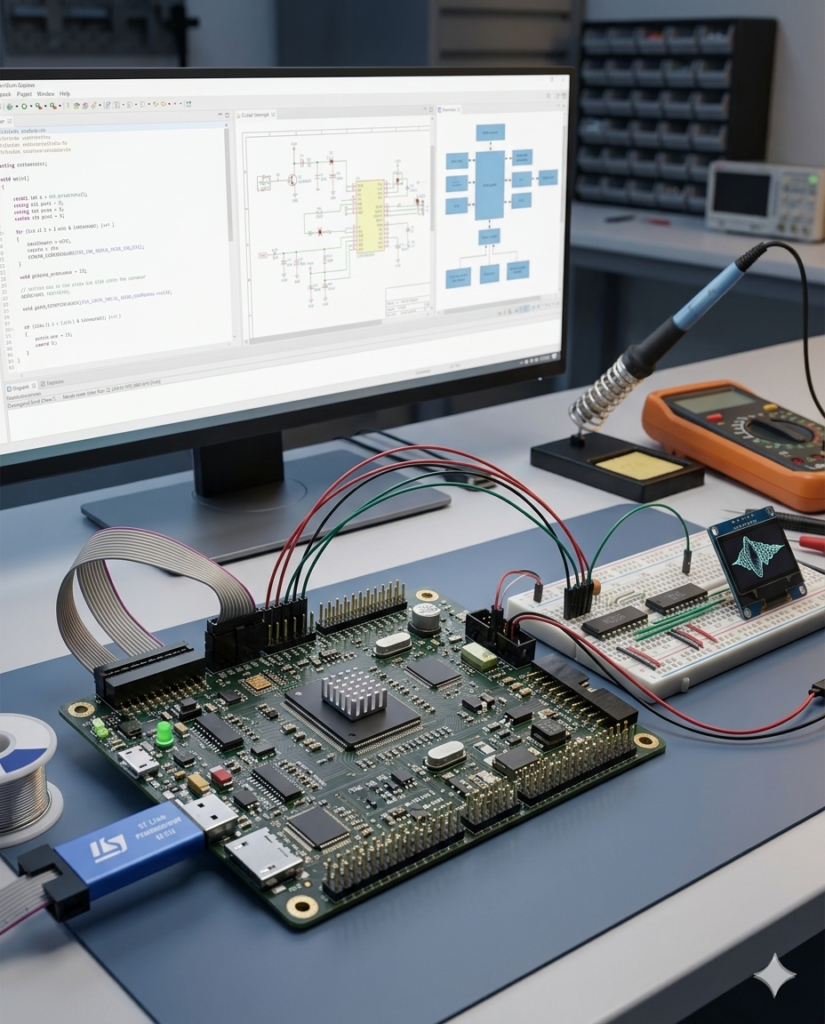
Embedded Systems Designs
Our mission is to be a premier engineering and hardware design partner, bridging the gap between physical components and intelligent software. By leveraging state-of-the-art microcontrollers, edge-AI processing, and robust firmware architecture, we develop custom embedded solutions that power the next generation of smart devices. We are committed to delivering high-performance, energy-efficient, and scalable designs that seamlessly drive automation and connectivity across industries.
To pioneer intelligent hardware solutions by seamlessly integrating AI and machine learning at the edge.
To architect low-power, high-efficiency systems tailored for complex industrial, automotive, and consumer electronics applications.
To provide end-to-end development architecture, from initial schematic design and PCB layout to firmware optimization and rigorous testing.
To bridge the gap between IoT connectivity and hardware security, ensuring robust data processing and secure device ecosystems.
To empower businesses to scale by transforming complex engineering challenges into market-ready, micro-targeted technology products.
✅ TASK 1: Functions in C and the Call Stack
🎯 Objective:
The primary objective of this session is to analyze how modular code execution functions under the hood by exploring the mechanics of the Call Stack in embedded architecture. Interns will study the hardware cost of executing functions, tracking how local variables, return addresses, and register states are pushed and popped from memory during routine execution. Understanding this structural data flow is vital for optimizing execution speed and preventing devastating hardware failures like stack overflow in highly resource-constrained microcontrollers.
📹 Session:
👉 Click here to Watch your uploaded session
📝 Task:
Write notes on:
Structure of Modular C Programming: Declarations, Definitions, and Scope
Introduction to Microcontroller Memory Allocation: The Role of the Call Stack
Mechanics of a Function Call: Stack Frames, Function Prologue, and Epilogue
How Parameters are Passed and Return Values are Handled in Memory
Storage Allocation of Local Variables inside Stack Frames
Understanding the Stack Pointer (SP) Register and its Movement
Causes and Critical Risks of Stack Overflow Bugs in Embedded Devices
Best Practices for Minimizing Stack Memory Footprint in Low-Level Firmware
🔬 Practice / Research:
Research what happens to a microcontroller when local variables inside functions exceed the allocated stack size limit. Write a short summary detailing the differences between global variables (stored in static memory) and local variables (stored on the call stack) regarding life-cycle and accessibility. List 3 debugging symptoms that indicate an embedded application is suffering from stack corruption or overflow.
📄 Practice Activity:
Write a short paragraph explaining: “How executing deeply nested function calls can exhaust microcontroller memory reserves, and why keeping function call depths shallow is essential for firmware stability.”
📊 Internship Task Completion Status Form:
After completing this task, interns must fill out the Internship Task Completion Status Form and upload their notes/practice work.
🔗 Form Link: https://forms.gle/kArakCDLG6aeCn218
✅ TASK 2: Modules, Recursion, ARM Application Procedure Call Standard (AAPCS)
🎯 Objective:
The primary objective of this session is to bridge high-level architectural design with low-level register management on modern ARM Cortex-M processors. Interns will investigate how complex projects are organized into clean, reusable multi-file modules using source and header files. Additionally, you will analyze the mechanics of recursive programming and evaluate why standard calling rules like the ARM Application Procedure Call Standard (AAPCS) are crucial for specifying how hardware CPU registers are systematically allocated during software operations.
📹 Session:
👉 Click here to Watch your uploaded session
📝 Task:
Write notes on:
Building Multi-File C Modules: Separating Interface (
.h) from Implementation (.c)The Role of Object Files and Linker Scripts in Code Modularization
Mechanics of Recursion in C and its High RAM Overhead in Embedded Applications
Introduction to the ARM Application Procedure Call Standard (AAPCS)
Hardware Register Allocation Rules: Core Registers (
R0-R3) for Argument PassingScratch Registers (Caller-Saved) vs. Preserved Registers (Callee-Saved)
Alignment Requirements for Stack Pointers in ARM-Based Systems
Evaluating the Structural Risks and Memory Penalties of Recursion in Real-Time Systems
🔬 Practice / Research:
Research why the ARM architecture utilizes core registers R0 through R3 to pass the first few function arguments instead of pushing them onto the slower RAM call stack. Write a short summary explaining why recursive functions are strictly restricted, or even banned, in critical automotive or medical embedded systems safety standards (like MISRA C). List 3 specific ARM registers that must be saved and restored by a function if they are modified during processing under AAPCS guidelines.
📄 Practice Activity:
Write a short paragraph explaining: “The difference between caller-saved and callee-saved registers according to AAPCS rules, and why this standard is vital for linking assembly code with C code seamlessly.”
📊 Internship Task Completion Status Form:
After completing this task, interns must fill out the Internship Task Completion Status Form and upload their notes/practice work.
🔗 Form Link: https://forms.gle/kArakCDLG6aeCn218
✅ TASK 3: Stack Overflow and Other Pitfalls of Functions
🎯 Objective:
The primary objective of this session is to deep-dive into the critical vulnerabilities associated with runtime memory allocation during function execution. Interns will analyze how the hardware stack behaves under intense operational conditions and explore common developmental slip-ups such as infinite recursion, oversized local variables, and invalid pointer manipulation. By the end of this task, you will know how to detect stack corruption and structure defensive code routines to maximize system reliability.
📹 Session:
👉 Click here to Watch your uploaded session
📝 Task:
Write notes on:
Mechanics of Stack Frames and Context Switching
Leading Causes of Stack Overflows in Bare-Metal Systems
How the CPU Behaves During a Hard Fault Triggered by Memory Corruption
The Dangers of Passing Large Structures by Value on the Stack
Evaluating Stack Allocation Sizes During the Build Configuration Phase
Understanding Return Address Corruption and its Safety Implications
Strategies for Early Diagnostics: Stack Paint and Guard Bands
🔬 Practice / Research:
Research how an embedded engineer can use a debugger (like GDB or an IDE) to inspect the Stack Pointer (SP) and locate where a crash occurred. Write a short summary detailing what a “Stack Paint” technique is and how it helps determine the maximum depth of stack memory used by code. List 3 clear symptoms a microcontroller displays when it experiences a subtle, non-crashing stack overflow.
📄 Practice Activity:
Write a short paragraph explaining: “Why recursive function strategies are heavily avoided in automotive or aerospace firmware layouts compared to traditional iterative loop strategies.”
📊 Internship Task Completion Status Form:
After completing this task, interns must fill out the Internship Task Completion Status Form and upload their notes/practice work.
🔗 Form Link: https://forms.gle/kArakCDLG6aeCn218
✅ TASK 4: Standard Integers (stdint.h) and Mixing Integer Types
🎯 Objective:
The primary objective of this session is to explore strict data-type portability and type conversion mechanics within target-dependent cross-compilation environments. Because basic C types (int, long) change sizes based on hardware architecture, embedded systems rely on precise bit-width types. Interns will study standard integer definitions, unexpected arithmetic behaviors from implicit type promotions, and mathematical pitfalls that happen when mixing signed and unsigned values in real-time equations.
📹 Session:
👉 Click here to Watch your uploaded session
📝 Task:
Write notes on:
Portability Dilemmas of Native C Primitive Types Across Different CPU Architectures
The Architecture of the
<stdint.h>Header File: Fixed-Width Integers (e.g.,uint8_t,int32_t)Under-the-Hood Mechanics of Implicit Integer Promotion Rules in C
The Pitfalls of Comparing Signed Integers with Unsigned Integers
Preventing Implicit Typecasting Hazards During Math Calculations
Evaluating Sign Extension and Its Behavior in Bitwise Right Shifts
Best Practices for Explicitly Casting Types in Safety-Critical Firmware
🔬 Practice / Research:
Research why comparing an expression like if (-1 < 1U) evaluates to FALSE in standard C rules. Show the step-by-step math conversion. Write a short summary defining why fixed-width integer declarations (like uint16_t) make firmware more portable between an 8-bit AVR and a 32-bit ARM Cortex processor. List 3 software calculation issues that occur when an intermediate math operation exceeds the capacity of its temporary hardware register storage.
📄 Practice Activity:
Write a short paragraph explaining: “Why relying on the default ‘int’ type instead of exact declarations like ‘int16_t’ or ‘int32_t’ can lead to unexpected compilation crashes during cross-platform hardware ports.”
📊 Internship Task Completion Status Form:
After completing this task, interns must fill out the Internship Task Completion Status Form and upload their notes/practice work.
🔗 Form Link: https://forms.gle/kArakCDLG6aeCn218
✅ TASK 5: Structures in C and Cortex Microcontroller Software Interface Standard (CMSIS)
🎯 Objective:
The primary objective of this session is to master the concept of mapping complex hardware profiles into highly organized C Data Structures (struct). Interns will explore memory alignments, padding layout structures, and how modern systems bundle complex data together. You will then see how this forms the cornerstone of the ARM Cortex Microcontroller Software Interface Standard (CMSIS), discovering how hardware peripheral control registers are directly mapped to C structure pointers for highly efficient device configuration.
📹 Session:
👉 Click here to Watch your uploaded session
📝 Task:
Write notes on:
Defining and Initializing Data Structures (
struct) in Embedded CMemory Realities: Understanding Alignment, Hardware Packing, and Padding Bytes
Utilizing Structure Pointers (
ptr->member) to Interface with Data PacketsCore Architecture of the CMSIS Standard for ARM Processors
Mapping Hardware Peripherals to Memory-Mapped C Structures
Using the
volatileKeyword Inside Struct Definitions to Represent Physical Control RegistersAdvantages of Using CMSIS Over Creating Custom Register Bit-Maps From Scratch
🔬 Practice / Research:
Research why a structure containing a char and an int might occupy 8 bytes of hardware RAM instead of 5 bytes, and how the #pragma pack(1) directive affects this layout. Write a short summary detailing how CMSIS simplifies porting an embedded software driver across two different microcontrollers using the same ARM Core architecture. List 3 essential system header files typically supplied by ARM’s CMSIS framework.
📄 Practice Activity:
Write a short paragraph explaining: “How a memory-mapped structure pointer allows an engineer to configure complex hardware registers (like a UART block) using intuitive object-oriented syntax in C.”
📊 Internship Task Completion Status Form:
After completing this task, interns must fill out the Internship Task Completion Status Form and upload their notes/practice work.
🔗 Form Link: https://forms.gle/kArakCDLG6aeCn218
✅ TASK 6: Startup Code Part-1: What is Startup Code and How the CPU Gets From Reset…
🎯 Objective:
The primary objective of this session is to pull back the curtain on bare-metal boot sequences, tracing execution steps from the exact millisecond power hits the silicon to the entry point of your main software. Interns will analyze the raw, under-the-hood initialization responsibilities hidden before the application launches. You will explore low-level assembly milestones, learn how hardware clocks and registers setup, and discover how the stack space pointer is prepared for system operation.
📹 Session:
👉 Click here to Watch your uploaded session
📝 Task:
Write notes on:
Definition and Primary Function of Startup Files (
startup_device.s/.c)The Hardware Reset Lifecycle of an ARM Cortex Microcontroller
The Reset Vector: How the CPU Determines the First Assembly Memory Target
Basic Tasks Executed Prior to the
main()Application CallInitializing the Master Stack Pointer (MSP) directly from low-level code
Turning on System Core Clocks and Basic Low-Level Hardware Peripherals
Understanding Assembly Directives Commonly Encountered in Startup Architecture
🔬 Practice / Research:
Research the physical behavior of an ARM Cortex-M CPU when the Reset line is toggled, explaining exactly what addresses it reads first. Write a short summary detailing why startup code is historically written in low-level Assembly instead of pure standard C language. List 3 key hardware conditions that must be established before the program is safe enough to hand execution control over to your main() routine.
📄 Practice Activity:
Write a short paragraph explaining: “What would happen to your firmware variables or functions if the microcontroller skipped executing the startup code block and hopped directly into the main function on power-up.”
📊 Internship Task Completion Status Form:
After completing this task, interns must fill out the Internship Task Completion Status Form and upload their notes/practice work.
🔗 Form Link: https://forms.gle/kArakCDLG6aeCn218
✅ TASK 7: Startup Code Part-2: Replacing the Vector Table and Embedded Software Build Pipeline
🎯 Objective:
The primary objective of this session is to master the construction of the Interrupt Vector Table and analyze the complete toolchain build pipeline. Interns will study how the hardware links internal/external interrupts to dedicated software handlers. Additionally, you will examine how the compiler, assembler, and linker coordinate to partition code into precise hardware memory locations, establishing complete control over the embedded binary creation workflow.
📹 Session:
👉 Click here to Watch your uploaded session
📝 Task:
Write notes on:
The Vector Table: Purpose, Memory Placement, and Structuring Interrupt Handlers
Customizing Vector Tables to Remap Interrupt and Fault Exception Lines
Deep Analysis of the Embedded Software Build Pipeline: Compiling, Assembling, and Linking
Understanding Key Compilation Memory Sections:
.text,.data,.bss, and.rodataRole of the Linker Script (
.ld/.sct) in Allocating Memory Sections into Flash and RAMCopying Initialized Variables from Flash (ROM) to RAM During the Runtime Boot Sweep
Clearing the
.bssMemory Area to Initialize Global Uninitialized Variables to Zero
🔬 Practice / Research:
Research the functional differences between the .data memory section and the .bss memory section inside a compiled micro-binary image file. Write a short summary detailing how the Linker Script knows the exact physical boundaries of the microcontroller’s Flash and RAM segments. List 3 common hardware exception channels contained within the top lines of an ARM Cortex vector table (e.g., NMI, HardFault).
📄 Practice Activity:
Write a short paragraph explaining: “The mechanism by which global variables that are initialized to a non-zero value (like int active = 5;) are maintained in non-volatile Flash storage and restored to active RAM at startup.”
📊 Internship Task Completion Status Form:
After completing this task, interns must fill out the Internship Task Completion Status Form and upload their notes/practice work.