Embedded Systems And IOT
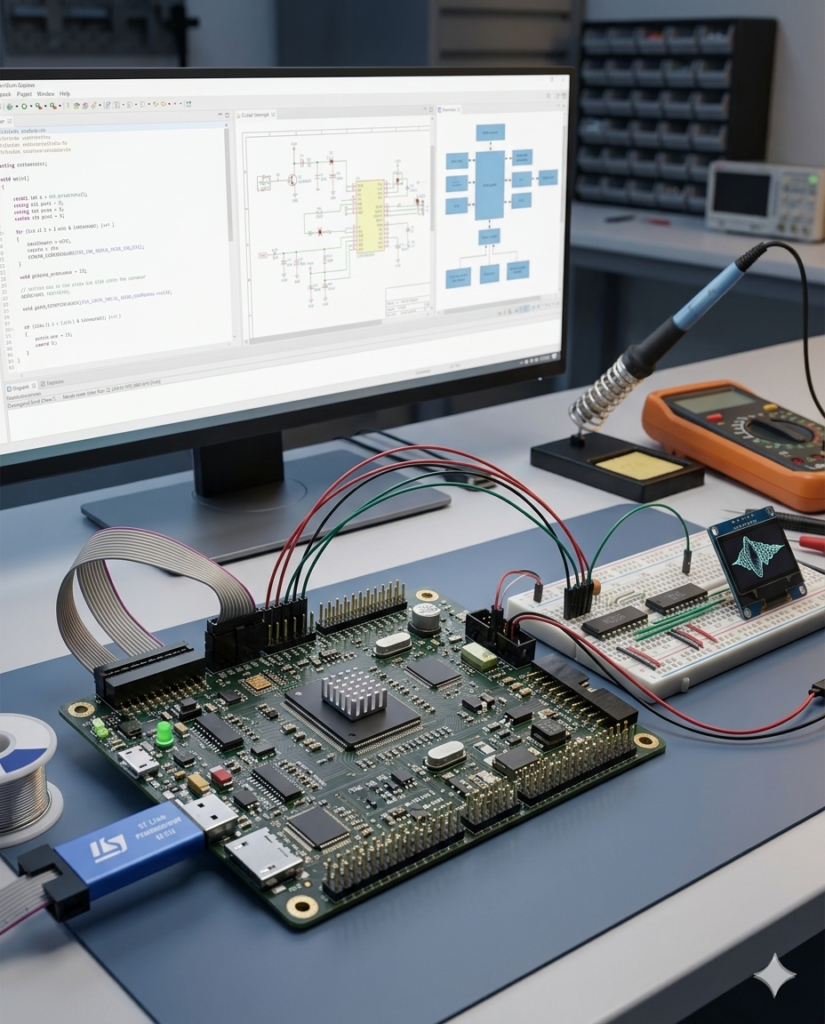
Embedded Systems Designs
Our mission is to be a premier engineering and hardware design partner, bridging the gap between physical components and intelligent software. By leveraging state-of-the-art microcontrollers, edge-AI processing, and robust firmware architecture, we develop custom embedded solutions that power the next generation of smart devices. We are committed to delivering high-performance, energy-efficient, and scalable designs that seamlessly drive automation and connectivity across industries.
To pioneer intelligent hardware solutions by seamlessly integrating AI and machine learning at the edge.
To architect low-power, high-efficiency systems tailored for complex industrial, automotive, and consumer electronics applications.
To provide end-to-end development architecture, from initial schematic design and PCB layout to firmware optimization and rigorous testing.
To bridge the gap between IoT connectivity and hardware security, ensuring robust data processing and secure device ecosystems.
To empower businesses to scale by transforming complex engineering challenges into market-ready, micro-targeted technology products.
✅ TASK 1: State Machines Part-6: What is a Hierarchical State Machine?
🎯 Objective:
The primary objective of this session is to master advanced behavioral organization through Hierarchical State Machines (HSMs). As embedded systems scale, traditional flat state machines suffer from an explosion of redundant states and repeating transitions. Interns will study the concepts of state nesting and behavioral inheritance, learning how a super-state can handle common events for multiple sub-states to keep your system design clean and maintainable.
📹 Session:
👉 Click here to Watch your uploaded session
📝 Task:
Write notes on:
Limitations of Flat Finite State Machines (FSMs) in Complex Systems
Introduction to Hierarchical State Machines (HSMs) and Behavioral Inheritance
Defining Super-states (Parents) and Sub-states (Children)
The Mechanism of Event Orthogonal Processing and Transition Topologies
How Sub-states Inherit and Override Transitions from Parent Super-states
Memory and Performance Trade-offs when Implementing HSMs in C/C++
🔬 Practice / Research:
Research a standard industrial use case (like an automotive power window or a missile guidance sub-system) that naturally benefits from a hierarchical state machine over a flat FSM model. Write a brief summary explaining what happens when an event triggers an action that is defined at both the sub-state level and the parent super-state level simultaneously. List 3 open-source state machine frameworks or design standards that natively support hierarchical structures.
📄 Practice Activity:
Write a short paragraph explaining: “How using hierarchical super-states drastically reduces the total number of transition lines needed in a design layout by grouping shared event handlers together.”
📊 Internship Task Completion Status Form:
After completing this task, interns must fill out the Internship Task Completion Status Form and upload their notes/practice work.
🔗 Form Link: https://forms.gle/kArakCDLG6aeCn218
✅ TASK 2: State Machines Part-7: Automatic Code Generation
🎯 Objective:
The primary objective of this session is to explore modern Model-Based Design (MBD) techniques by studying automatic code generation. Manually translating complex state diagrams into C logic is a slow, error-prone process. Interns will explore how automated modeling engines interpret visual state behaviors to produce optimized, production-ready source code. This bridges the gap between visual system architecture and physical implementation.
📹 Session:
👉 Click here to Watch your uploaded session
📝 Task:
Write notes on:
Principles of Model-Based Design (MBD) in Enterprise Firmware Engineering
How State Chart Modeling Utilities Translate Graphics Into Structural Layouts
Automated C Code Engine Formats: Matrix Layouts vs. Conditional Switching
Ensuring Safety and Compliance (e.g., MISRA C) Using Autogenerated Code
Methods for Integrating Autogenerated Code Arrays with Manual Device Drivers
Debugging and Validating Autogenerated State Files at the Hardware Register Level
🔬 Practice / Research:
Research a popular industrial modeling toolchain (such as MATLAB/Simulink Stateflow or QM Modeling Tool) used to automatically generate state machine code. Write a short summary discussing the advantages and disadvantages of relying on autogenerated code versus hand-written code regarding optimization and long-term maintenance. List 3 strict software engineering safety standards (like ISO 26262 for automotive) that encourage using verified model generation tools.
📄 Practice Activity:
Write a short paragraph explaining: “The core step-by-step workflow an engineer follows when updating a system feature using a visual model instead of manually editing lines of C code inside a source file.”
📊 Internship Task Completion Status Form:
After completing this task, interns must fill out the Internship Task Completion Status Form and upload their notes/practice work.
🔗 Form Link: https://forms.gle/kArakCDLG6aeCn218
✅ TASK 3: Active Objects in Real-Time Part-1: Run-to-Completion and RMS_RMA
🎯 Objective:
The primary objective of this session is to study deterministic scheduling for event-driven systems by combining Active Objects with Rate Monotonic Scheduling (RMS) and Rate Monotonic Analysis (RMA). Interns will analyze how Run-to-Completion (RTC) event handling operates within strict real-time deadlines. You will learn to use math-based analytical frameworks to assign task priorities, analyze worst-case timing scenarios, and prove mathematically that your concurrent active threads will never miss an operational deadline.
📹 Session:
👉Click here to Watch your uploaded session
📝 Task:
Write notes on:
Blending the Active Object Design Framework with Real-Time Scheduling Rules
The Interaction Between Run-to-Completion (RTC) Steps and Preemptive Priorities
Introduction to Rate Monotonic Scheduling (RMS): Static-Priority Scheduling Theorems
Utilizing Rate Monotonic Analysis (RMA) to Mathematically Calculate System Schedulability
The Concept of CPU Utilization Bounds ($U = \sum \frac{C_i}{T_i} \le n(2^{1/n}-1)$)
Analyzing and Mitigating Jitter and Blocking Delays in Asynchronous Priority Networks
🔬 Practice / Research:
Research the fundamental rule of Rate Monotonic Scheduling regarding how the execution period ($T$) of a periodic task relates to its assigned priority level.
Given three active threads with execution times $C_1=1\text{ms}, C_2=2\text{ms}, C_3=5\text{ms}$ and periods $T_1=4\text{ms}, T_2=10\text{ms}, T_3=20\text{ms}$, calculate the overall CPU utilization and check if it is mathematically schedulable under standard RMS limits.
List 3 architectural pitfalls that can lower your calculated processing window and cause an active system to fail its real-time testing.
📄 Practice Activity:
Write a short paragraph explaining:
“Why assigning thread priorities based mathematically on execution frequencies (RMS) is safer and more reliable than setting priorities using guesswork during testing.”
📊 Internship Task Completion Status Form:
After completing this task, interns must fill out the Internship Task Completion Status Form and upload their notes/practice work.